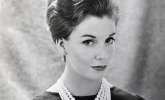
Miss May Does Not Exist: The Life and Work of Elaine May, Hollywood’s Hidden Genius By Carrie Courogen
St Martin’s Press £23.75
Being a dedicated Elaine May fan, I could not wait to get my hands on this book.
Nor was I disappointed. Carrie Courogen has done stunning research, despite the many obstacles in her path, bringing the elusive director, comedian and actress fully into focus.
She calls it Miss May Does Not Exist – the way Elaine described herself on her 1958 comedy album, Improvisations to Music, done with Mike Nichols.
It is an apt title, as much of Elaine’s work has been done without credit or acknowledgment. She likes to work in the shadows. Naturally, she refused to co-operate with the author, who once donned a wig and sat on a bench monitoring the entrance to her Upper West Side apartment, in the hope of catching a glimpse of her recalcitrant subject. A recent interview reveals that, predictably, Miss May has remained silent since publication.
For some years, I have been an apostle for the subtly funny Mike Nichols-Elaine May dialogues that filled a Broadway theatre in the late 1950s. Between them, they more or less created comedy improv, bouncing words and situations off each other with the same dexterity jazz musicians show when they play together.
I have relished Elaine’s 1972 film, The Heartbreak Kid, since I first saw it in 1984. It dealt with the dilemma of a young man (Charles Grodin) falling in love on his honeymoon with a blonde (Cybill Shepherd), while his bride (Jeannie Berlin, in real life Elaine May’s daughter) languished in their room with diabolical sunburn. I fear the realisation of the commitment of marriage must sometimes inspire such an agonising situation.
To review this book, I had fun watching Elaine May films to see what I thought and what the author then had to say. So I screened A New Leaf, which Elaine directed in 1971, with her starring opposite Walter Matthau.
A New Leaf is about a man who runs out of money, and has to marry an heiress. He finds an unco-ordinated botanist, played by Elaine, with smudged lipstick, clumsily spilling her tea.
When Elaine finished the edit, the film was three and a half hours long. The studio cut it, and to her fury they removed the essence of the film, including two murders by Matthau, as he planned to kill his bride – making the film ending what she called ‘cliché-ridden, banal’. Her co-star Walter Matthau commented that Elaine ‘makes Hitler look like a little librarian’.
I also watched Ishtar, deemed a monumental failure in 1987, but considerably redeemed on reissue. This film was meant to be a take on the Road to… films of Bob Hope and Bing Crosby. I can see how it was a studio budget disaster waiting to happen, with its exotic Moroccan and desert locations, especially as the press picked up on how much Warren Beatty and Dustin Hoffman were being paid.
I thought it was rather fun. Most people hated it. As Elaine said, ‘If everyone who hated Ishtar had actually seen it, I’d have been a rich woman.’
The joy of this biography is that, with each film in turn, Carrie Courogen takes us behind the scenes and tells us exactly what went on in production.
Elaine May’s problems were manifold. It was not easy to be one of the first women directors on films. She was judged more harshly than a man would have been if something went wrong (which it often did). She was a perfectionist, demanding endless retakes to get exactly what she wanted. This set her against the money men, as she invariably exceeded the budget.
And she was experimental. She wanted to do imaginative and innovative things, and this was invariably in opposition to the more obviously commercial approach of the studios, who pandered to audiences, assuming they liked schmaltzy endings.
Yet the author makes it clear that the development of films owes much to this elusive director.
Elaine May survived a nomadic childhood and a scratchy education. She became a revolutionary influence in sketch comedy. She scripted The Birdcage and Primary Colors. She doctored Heaven Can Wait, Tootsie and Reds. She lives on at the age of 92 and has inspired from Carrie Courogen a biography that has already been highly praised on the other side of the Atlantic.
I greatly recommend it.
Hugo Vickers has written biographies of the Duchess of Windsor, Queen Mary and the Queen Mother