GLADIATORS OF BRITAIN Dorset Museum
to 11th May HANS COPER: RESURFACE
The Arc, Winchester, to 24th March
It’s a 12-minute walk from Dorchester Museum to neolithic Maumbury Rings, turned by the Romans into an amphitheatre. It isn’t known if gladiators fought there (although Hardy implied it in The Mayor of Casterbridge).
But, as well as Gladiator II, the amphitheatre is a good peg for this show, organised by the British and Colchester and Ipswich Museums.
Many Roman artefacts have been excavated in Dorchester and are held in the museum, but one of the most evocative exhibits comes from Colchester.
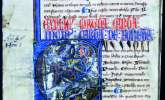
It is a 2nd century AD cremation vessel (pictured), with a fight between a secutor, armed with short sword and shield, and a retiarius with net and trident.
A gladiator’s helmet (pictured) from Suffolk comes from the BM, as do a hoplomachus (short sword, round shield and spear) and a thraex (Thracian sword and square shield).

After Dorchester, the show will travel, to Northampton Museum (24th May-7th September), Grosvenor Museum, Chester (20th September- 25th January 2026) and Tullie House, Carlisle (7th February-19th April 2026). While Lucie Rie’s name and pots are widely known, even among those who know little else of modern British ceramics, many potters rate her former assistant Hans Coper (1920-81) still more highly. She agreed: ‘I am a potter, but he was an artist.’


This was not just terminology, but a recognition of a difference in their practice. She threw pots on the wheel, whereas he, after throwing elements, hand-built them into sculptural – but always functional – forms. After 12 years with her, he set up his own studio in 1958. In 1961, he was commissioned to create three murals: for the Royal Army Pay Corps barracks in Winchester, the Powell Duffryn group’s London offices and Swinton School, Rotherham.
All have left their original sites, and for one time only they are shown together. The 10-foot-high rendering of the RAPC cap badge has long been stored, but will soon be installed at the Winchester Adjutant General Corps museum.
The other two are ceramic discs. The first was moved, rearranged and then sold to a German collector in 1985. Last year, it was sold again, for €340,000 (£283,335), to an American. Swinton School was demolished in 2009, but its mural was rescued and is privately owned. With the murals are about 20 Coper pots, and studio photographs taken by his widow.