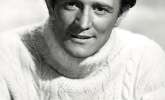
Before John Sergeant became a political journalist, and a Strictly sensation, he appeared on Alan Bennett’s 1966 satirical sketch show, On the Margin. They are pictured here on the show, together with Virginia Stride. Sergeant recalls seeing the young Bennett at work.
It’s more than 50 years since I teamed up with Alan Bennett to try to make people laugh.
We have only met on a few occasions since, but I like to think we keep an eye on each other from a distance. In the latest edition of his diaries in ‘Keeping On Keeping On’, Alan reveals his thoughts on hearing of one of my more recent escapades.
‘20 November. John Sergeant retires from the Strictly Come Dancing competition. I have no views on this but, having worked with Sergeant on a BBC comedy series in 1966, I can truthfully say that, whatever he knows about rhythm and dance (i.e. nothing), he learned from me.’
Like most of Alan’s best remarks, it is funny without being malicious; it should be spoken with a slightly mournful, northern accent, and with a straight face.
Having enjoyed Alan’s brand of humour for so many years, I can’t help but cherish this personal joke. I hope it means he appreciated the reason I gave for resigning from ‘Strictly’ after ten weeks on the show.
‘There was,’ I suggested, ‘a real danger that I might win.’
Appearing with Alan in the six episodes of his only television sketch show, ‘On the Margin’, in 1966, is among my most treasured memories. One of the sketches involved me trying to keep up with fashion, addressing what in those days would be called an effeminate antique dealer.
SERGEANT: Have you any camp teapot stands?
BENNETT: Do you know, if you’d come in here a week ago, I was knee deep in camp teapot stands. I’ve had teapot stands in this shop as camp as a row of pink tents.
SERGEANT: Really?
BENNETT: I tell a lie – as camp as a row of pink,frilly tents.
It was not my intention to become a comic actor after leaving Oxford. Pure chance made it possible. At my college, Magdalen, Alan was famous as an academic. His introduction to High Table was part of folk legend. Too embarrassed to admit being trapped in his scholar’s gown and unable to move his arms, he decided to have nothing to eat.
Alan was a student hero because of his performance in Beyond the Fringe, which gave my generation a clear lesson in what was funny, a template for the jokes to sustain us in the long, rambling conversations of our youth. I had seen the show on Broadway in New York, when I was in my gap year. It never occurred to me that I would work with one of its glittering stars.
As a student, I had written jokes and performed in cabaret. But my brother was an actor and I knew far too much about the disappointments and frustrations of a life on the boards. Instead, I was accepted as a journalist trainee by the news agency Reuters.
I was due to begin in September, on a salary of just over £800 a year. The last long vac beckoned and, further ahead, the grim prospect of permanent employment. Surely it was reasonable to have one last stab at frivolity, taking part in the Oxford revue at the Edinburgh Festival?
Alan Bennett was on the lookout for a member of the small team he was assembling for On the Margin. He had already turned down the starry Michael Palin, who had left Oxford the year before. I think he wanted someone with as little connection as possible to the extravagant life of the theatre; someone unlikely, perhaps someone a little like himself.
After a few fairly desultory remarks, Alan suddenly turned to me and said, ‘Would you like to be in my television comedy series?’
I was the only member of the cast whose eyes were not set on some kind of showbiz career – so it took me some time to recover.
‘I am not sure,’ I spluttered. ‘My father would be very disappointed. He’s a vicar, you see, and he did not like your sermon sketch in Beyond the Fringe. In fact, he blames you personally for the decline of the Church of England.’
It was Alan’s turn to be nonplussed.
‘But what about your mother?’ he suggested tentatively, not even sure my mother was still alive.
‘Oh, she’ll be all right,’ I replied, ‘She usually works out good reasons for agreeing with me.’
I was torn. I had fought long and hard to get that Reuters job. Accepting Alan’s offer would be a leap in the dark. He did not press me for an immediate decision. He simply suggested delivering the scripts to my lodgings next door.
On reading them, I knew immediately my fate was sealed. The producer, Patrick Garland, flew up to Edinburgh to see me. There was earnest talk of contracts and repeat fees. I was 22 and, before long, I was in those rehearsal rooms.
The bit I hugely enjoyed was listening to Alan, with his marvellous voice and those clever lines. In one of the sketches, I narrated a film, with him as a pretentious northern writer.
‘My father was a miner,’ Alan solemnly proclaimed, ‘My mother is a miner. These are miners’ hands.’
What a joy it was!
Alan had discovered what would be his own special goldmine. From everyday, northern speech, with its lilting rhythms and abrupt turns of phrase, he dug out humorous gems.
Many others, most notably Victoria Wood, have worked the same vein, but Bennett Originals stand supreme. With my wife, Mary, who was brought up in a village near Preston, I have developed a keen ear for the unmistakable sound of Bennetts.
They are not always old ladies from Lancashire and Yorkshire, innocently going about their business, but being like that certainly helps.
I was struck by a story, told to me by one of Alan’s friends, of how, as a young boy, only eight years old, Alan had travelled with his aunt on a tram in Leeds.
‘Look over there,’ she pointed, ‘That’s the biggest gasometer in Europe.’
She followed this quickly with the perfect Bennett Original punchline: ‘And I know the manager.’
Being able to remember that sort of exchange, even as a youngster, and repeat it for effect, has turned Alan into a national treasure, however much he may pooh-pooh the idea. It takes an artist to record and identify this found poetry. And he has always worked diligently at his art.
When I was in On the Margin, Alan would always carry a small, black notebook, ready to pick up on an interesting remark, like a sweet he could push into his pocket for use later.
For me, the most rewarding moment was when I produced what I thought was a bon mot – and then to have it apparently confirmed when Alan reached for his notebook. But was it really something I had said? He may just have been diverted by one of his own thoughts.
He is still constantly accumulating nuggets. One of Alan’s fans told me a story at the Oldie of the Year Awards Lunch this year. Soon after the European referendum, Alan fell off his bike in Regent’s Park and two French people rushed to help him get up.
‘I felt like apologising,’ said Alan, a committed Remainer. And, immediately, he stored it away as a nugget, perhaps in his notebook.
Fifty years ago, I had to take that big career decision: onwards and upwards as an actor, or settle for journalism? I made my choice. By the time On the Margin won the Royal Television Society Award for the Best Comedy of the Year, I was a trainee reporter on the Liverpool Daily Post and Echo.
But that wasn’t the end of my very happy link to Alan Bennett. After three years of training in Liverpool, I was taken on as a staff reporter in London for BBC News. Alan kindly gave me a reference.
When I left, thirty years later, as chief political correspondent, on my way to ITV as political editor, I went to a final meeting with my line manager. He pushed a brown paper envelope across the table.
To my astonishment, inside was the reference for me Alan had written all those years before. He had praised me generously and finished by saying, ‘Last but not least, he has a good sense of humour, and I hope he gets the job.’
I was rather overcome. I stood up, asking if I could take this rare, flattering artefact with me, written as it was by the great man.
‘Oh, that’s all right,’ the manager said. ‘It’s only a copy.’
It was a very BBC reply. And, in its gentle puncturing of pride, it could have qualified as a Bennett Original.