
He lost the Battle of Hastings but he’s the star of the Bayeux Tapestry
We are, it seems, very excited as a nation about the arrival of the Bayeux Tapestry in September – just before the 960th anniversary of the Battle of Hastings on 14th October.
The British Museum is encouraging us to mark 1st July in our diaries as the day we can all club together to crash its website while trying to buy tickets.
The museum’s chair of trustees, George Osborne, has said, ‘This will be without doubt the biggest year in the museum’s history – as we expect 7.5 million people to visit, and the Bayeux Tapestry returns to UK soil for the first time in 1,000 years.’
Well, almost 1,000, but figures were never the former Chancellor’s thing.
To commemorate the Battle of Hastings, biographies of the two main combatants are being published.
David Bates’s William the Conqueror, originally published in 1989, is being reissued in August. And Tom Licence’s Harold – The Warrior King is also coming out in August, on the eve of the battle.
By the way, it’s only worth pointing out, ‘Actually, it’s an embroidery’, if you can also explain how a tapestry proper is made. No, me neither.
Considering this is the victor’s narrative, it is surprising the most important person in the tapestry is undoubtedly its biggest loser.
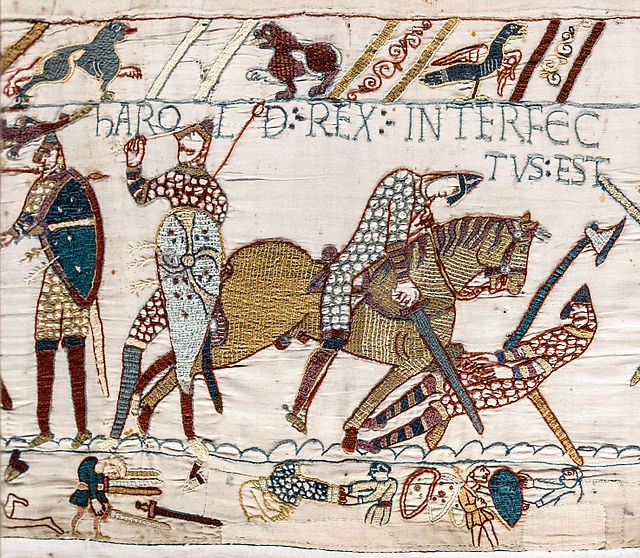
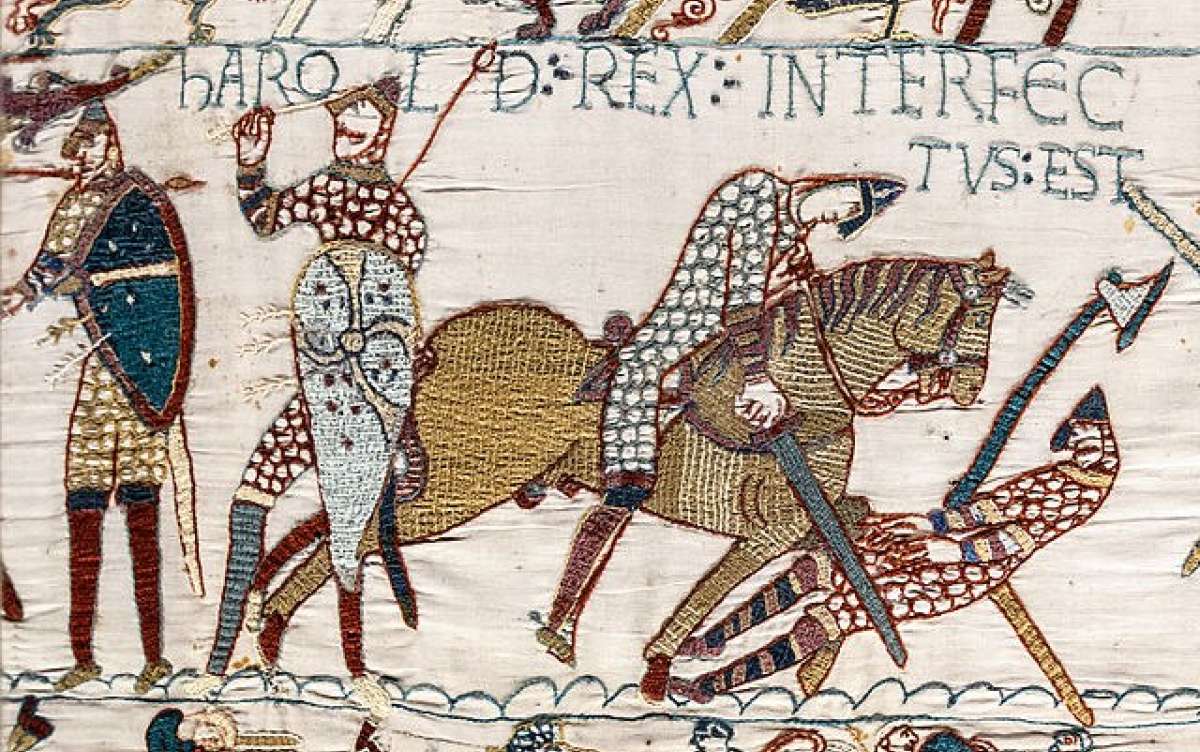
Not only is Harold the subject of the most famous and disputed depiction of a royal death in English history – ‘Hic Harold Rex Interfectus Est’ (‘Here, Harold was killed’).
He is also the star from the very beginning, taking his leave of Edward the Confessor and setting off for Bosham for his fateful trip across the Channel, where he will encounter Duke William for (we assume) the first time.
Harold II became king on January 5, 1066, after the death of Edward the Confessor, and reigned for just over nine months before his death at the Battle of Hastings.
Harold’s death scene – is he the man with the arrow in his eye, the one being hacked down by a mounted knight or, despite different legwear, both? – is not the only confusing one he features in.
The crucial moment where he swears on relics, making a ‘sacramentum’ (an oath) to Duke William, has him laying his hands on two cabinets, which one assumes contain sacred objects. But the tapestry’s text doesn’t enlighten us as to what Harold swore.
Before that scene, Harold has been depicted as something of a hero. He accompanies William on a campaign against his enemy Conan of Brittany. And he apparently saves his hosts by dragging them from the quicksand as they struggle to cross a river.
If the tapestry was your only guide, it would be difficult to discern that the man who did this, and to whom William ‘gave arms’ (ie, knighted), was supposed to be a double-crossing usurper.
Harold’s rise to the throne looks similarly uncontroversial. In the tapestry, his brother-in-law, the childless Edward the Confessor, is seen to greet the returning Harold. Perhaps Harold looks sheepish, but it’s impossible to be sure. Then the king consults his ‘fideles’,
his faithful followers, and dies. Oddly, we see his body taken to Westminster Abbey before the panel in which he is declared ‘defunctus’ – or dead. Next, ‘they’ (presumably those just consulted) have ‘given the king’s crown to Harold’.
Historians sometimes point out that the appearance of Archbishop Stigand, named in the tapestry, as he stands beside an enthroned Harold, is an indication the tapestry’s commissioners want to show that Harold was an illegitimate king.
Stigand was not recognised by the Pope and was removed as Archbishop after the Conquest. But he isn’t even shown crowning Harold (his coronation is thought to have taken place in Westminster Abbey), making this more of a nudge than a Norman takedown.
Very soon after this, with only the appearance of Halley’s Comet and the unexplained visit of an English ship to Normandy intervening, preparations are afoot for the invading Norman fleet. The tapestry’s most vivid and memorable scenes follow.
Harold can hardly be held up as a successful king: he lost his throne, after all, and he barely had any time to do anything but resist the two rulers who tried to take it from him.
He succeeded against one, Harald Hardrada, unnamed in the tapestry, at the Battle of Stamford Bridge on September 25, 1066.
But even the victors’ account of his downfall at the hands of the other, William the Conqueror, preserved in one of France’s greatest treasures, portrays him as a worthy opponent.
I’ll be joining the queue to see it for myself.
The Bayeux Tapestry is at the British Museum, September 2026 to July 2027