In 2017, Spotlight printed its final casting directory, ending a 90-year tradition.
These were books not for the public but for Wardour Street film-makers, directors of repertory companies and, latterly, TV producers. By the end of the 1940s, a full-page ad cost an actor or their agent £25 a year. In the early 1960s, Spotlight had records of over 17,800 performers and answered over 200 enquiries a day.
Collecting old copies is not a cheap pastime, and the average volume is the size of a GPO telephone book, but they are irresistible to any devotee of British cinema – I now own 15 issues.
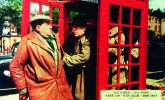
One attraction is how some actors established their personae early on in their screen careers. The May 1949 issue has a beady-eyed Donald Pleasence and Sidney James apparently poised to sell a dubious used car.
Other entries convey an image at odds with an actor’s familiar persona or remind you when a TV presenter once had theatrical aspirations. The Sean Connery of 1958 (‘Under contract to 20th Century Fox’) sported the white tie and black shirt of a Soho wide boy. Corona Academy of Stage Training showcased a fresh-faced Dennis Waterman in Actresses and Children – Spring 1963.
In 1949, the Juvenile-Character Men pages contained a picture of a menacing Eamonn Andrews, while the Juvenile Men section had a grim-visaged 25-year-old Nicholas Parsons. Any B-film producer needing someone to play a spiv should contact him on HAMpstead 3747.
London telephone exchanges, reminiscent of an Agatha Christie novel, are another appealing aspect of Spotlight before the late 1960s. Several character actors would list their home numbers as well as their agent’s. A 1956 issue has Charles Hawtrey giving his home address of 217 Cromwell Road, Hounslow, as a contact. Either he was between agents or, equally likely, he was saving £sd. Hawtrey also decided, somewhat ambitiously, to bill himself as a Leading Man.
The back pages of a directory had quarter-page entries from such young actors as John Osborne, Liz Fraser or David Baron, aka Harold Pinter.
Many of these smaller advertisements convey a sense of quiet desperation: character actors who hoped a casting director would contact them ‘c/o Spotlight’ or call their bedsit on a FLAxman telephone number. One 1964 bit-part actor is available for ‘Town Tour or First-Class Repertory’. Another could perform his ‘Own Straight and Comedy Numbers with Banjetta’.
Nor is this sense of melancholy restricted to minor players ‘just returned from a successful tour of the Isle of Wight’. Rank and Associated British would commission full-page advertisements for their contract artists, many of whom are now forgotten. Among these screen deities was Carole Lesley (1935-74), a blonde bombshell who killed herself. There are lost stars who once opened provincial supermarkets and garden fêtes.
Spotlight began listing performers online in 1997, and two decades later the printed directory was no more. For some collectors – like me – their appeal waned by the 1970s, despite the fascination of middle-aged actors unwisely adopting Jason King hairstyles. Spotlight’s heyday was the postwar era when Roy Plomley was an aspiring Leading Man. And when you could call Charles Hawtrey at home on HOUnslow 0636.
Andrew Roberts, author of Idols of the Odeons: Post-War British Film Stardom