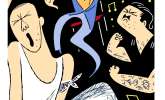
Soho Place, London, until 21st February 2026
Graham Greene, a man not given to superlatives, called The Spy Who Came in from the Cold ‘the best spy story I have ever read’. What makes John le Carré’s Cold War novel so good? And how well does it work onstage?
Le Carré wrote this haunting, understated thriller at the age of 30, while working as a ‘junior diplomat’ (as he put it) at the British Embassy in Bonn. In reality, he was working for MI6 – Britain’s Secret Intelligence Service.
This inside knowledge gave le Carré what all writers crave – the ring of truth. He’d found that literary sweet spot, ‘where reality goes through the secret door to fiction’. This, his third novel, was his first bestseller – and the last book he wrote while working as a spy. Written ‘under intense, unshared personal stress, and in extreme privacy’, it has a clandestine, undercover flavour, as if the very act of writing it was a form of espionage.
For the benefit of anyone who hasn’t read the book or seen the 1965 film (and if you don’t know either, you’re in for two terrific treats), this is the story of a spy at the end of his tether – the opposite of James Bond.
Alec Leamas has returned to Britain under a cloud, after the eradication of his Berlin network. His East German nemesis, a man called Mundt, has killed all his secret agents. Relegated to a dead-end desk job, he turns to drink and ends up in prison after assaulting a shopkeeper in a drunken rage.
Yet this descent into the gutter is really an elaborate charade, a ruse to trick Soviet agents into thinking he’s ripe for recruiting. Sure enough, Leamas ends up behind the Iron Curtain, having supposedly defected to East Germany, where he can take his revenge on Mundt – this time from the inside. However, as this mendacious plan unravels, Leamas begins to wonder – are his British handlers also deceiving him? Is there anyone he can trust at all?
The book was published in 1963, to great acclaim, and filmed two years later, with Richard Burton giving a mesmeric performance as Leamas. There have been numerous movies of le Carré’s other novels, and various TV series, most notably starring Alec Guinness as the gnomic spymaster George Smiley. So why is this the first time his work has been adapted for the stage?
Le Carré’s son Simon Cornwell provides an illuminating answer to that question. It’s partly, he says, because le Carré’s own attempts at playwriting met with painful rejection, and also because ‘Theatre, particularly in the chattering England of the Home Counties, was I think in our father’s eyes almost the perfect embodiment for the class distinction he so abhorred.’
Happily, towards the end of his life, le Carré gave award-winning playwright David Eldridge the go-ahead to write this powerful adaptation. Although I should declare an interest (it turns out we share the same agent), I’m sure I won’t be the only one to say he’s done a very good job indeed.
Eldridge’s staging remains faithful to le Carré’s story, and it also draws out the drama – no mean feat in a tale with a complex, perplexing plot, in which much of the action consists of cryptic, enigmatic conversation. His script is brought alive by Jeremy Herrin’s bold, balletic direction. Played in the round (which invariably makes a play feel much more intimate), it’s an intense and claustrophobic spectacle, and just as enjoyable as the book.
There are many fine performances, especially John Ramm’s; he doubles up as the genial, elusive Smiley and his jovial, malevolent East German counterpart. But the show belongs to Rory Keenan, as the embittered, beleaguered Leamas. Burton’s performance casts a long shadow, yet Keenan escapes it.
Rugged and dishevelled, he’s driven to the edge of insanity by a life of duplicity and subterfuge. His constricted, volatile portrayal is entirely his own.
‘What do you think spies are – priests, saints and martyrs?’ asks Leamas. ‘They’re a squalid procession of vain fools; traitors too, yes. Pansies, sadists and drunkards; people who play Cowboys and Indians to brighten their rotten lives.’
What makes The Spy Who Came in from the Cold such a great story is that, to his own surprise, Leamas turns out to be quite the opposite. No saint, to be sure, but a martyr to love – the only true cause.