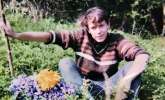
The word ‘tragic’ is often misused nowadays. It’s fitting to apply it to the life of my friend and literary collaborator Matthew Leeming, who died at the end of November at the early age of 58.
Matthew’s life was tragic in the Greek sense of the word, with a descent from a high estate down to the depths.
As an Oxford undergraduate, he shared a house with Boris Johnson, and was regarded as one of the most brilliant and promising members of a gilded generation there in the mid-1980s.
In the early 2000s, thanks to his work in Afghanistan he was fêted as the next big thing in travel writing – as if ‘Hunter S Thompson meets Robert Byron’, one critic said.
Yet he was not simply a man of letters. He was also an irrepressible entrepreneur. Every time you saw him, he was on the trail of a new venture – often in Afghanistan: oil, gold, gems, marble, tourism, printing.
In the last decade of his life, he spent time on the streets, not just back in Oxford, but also sleeping rough in the graveyard of the church in which he was baptised.
His decline, after the failure of a 2012 venture (the supply of jet fuel to Afghan NATO bases), came in spite of the best efforts of many friends to help him.
Although he regained some of his earlier equanimity in the last year of his life, resuming his literary journalism and business schemes, years of self-neglect caught up with him, being the most likely reason for his early death through as yet undetermined natural causes.
Underlying both his prosperity and his collapse is the fact that he maintained in all his dealings the mien of an Edwardian adventurer. In essence, he was a gentleman anarchist. A gentle and scholarly soul at heart, he suffered an angrily abusive upbringing at the hands of his father and terrible bullying as a boy at Bradfield. As a result, he was inclined towards Quixotic quests that would bring him security and esteem, while at the same time giving way to self-destructive tendencies and taking pleasure in shocking sensibilities, challenging authority and causing chaos all around.
His long sojourns in Afghanistan allowed him to give free rein to these aspects of his character. He mentions in his diary how happy he was in Kabul drinking vodka and listening to Don Giovanni on headphones while sitting one table along from a Mujahideen warlord: ‘[I] felt I had found all I wanted: alcohol, Mozart, a weird and slightly dangerous city.’
Matthew had been personally encouraged to go to Afghanistan by the great explorer Sir Wilfrid Thesiger. Thesiger told Matthew that Afghanistan was one of the few places left where one could still explore in an old-fashioned way.
This Matthew did, to the full. Under the guidance of the Oxford classics don Robin Lane Fox, he hunted for traces of Alexander the Great, running genetic tests on the blond-haired inhabitants of the Hindu Kush to see whether they were descended from Alexander’s Greek soldiers, and mounting expeditions to the ancient lapis-lazuli mines.
The Spectator carried his dispatches from the country, where he recounted extraordinary happenings: a visit to a Kabul prison death row, in which he found high comedy; an interview with a Hazara man who was forced by the Taliban to plant explosives in the Bamiyan Buddhas.
He remains most famous for the account of his accidental meeting with the suicide bombers who killed the anti-Taliban leader Ahmad Shah Massoud just before 9/11. He failed to recognise them as suicide bombers, and even loaned them his satellite phone.
In 2005, he wrote with me the first full guidebook to the country to be published since the 1970s. His own uproariously funny travel narrative of the country remains unpublished. In an example of his self-destructive streak, he refused to remove a small number of jokes at the request of his – in his eyes – over-censorious editor, as a result of which the book was pulled.
His anarchic, self-destructive tendencies meant personal relationships with him were fascinating but difficult.
Once he cheerfully greeted a friend and his two children calling at his cottage in Alresford with ‘Hello, I’ve just shot a swan!’ He told me the ashtray he was using at the cottage was Stalin’s soap dish, which he had gleefully stolen from Stalin’s train in Georgia (this artefact is presumably now lost).
As a visitor, he left a trail of devastation: chocolate-mousse handprints up staircases, or kitchens covered in dried spaghetti and Nicorette chewing gum.
His unruliness belied a genuine care for Afghanistan. He was scandalised by the British abandonment of interpreters and others who had helped the allies there.
To the end of his life, he made every endeavour to support them. Like many an apparently supercilious Edwardian adventurer, he had a profound love for the country he spent years exploring.
For this, as much as for his other achievements, we should remember him.
Afghanistan: A Companion and Guide (Odyssey) by Bijan Omrani, Matthew Leeming and Elizabeth Chatwin is out now
The Oldie February 2023