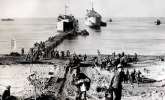
Jan Karpiński salutes his father's death-defying contribution to a crucial operation.
Sometimes, good people have to join together and risk their lives to stop aggression and gangsterism. Here is a small example from 80 years ago.
On the morning of 21st September 1944, 114 Douglas C-47 transport planes of the US Army Air Force took off from airfields in England with 1,543 Polish paratroopers on board.
Some of the planes had been nicknamed by their crews. My father, Captain Stanisław Karpiński, was on board a plane called The Wild Hare – echoing the title of the first Bugs Bunny film, released by Warner Brothers in 1940.
The Poles were on their way to the Battle of Arnhem, part of Operation Market Garden – an ambitious Allied Second World War offensive. The plan was for a spearhead of British tanks to race across 100 miles of German-occupied Holland, over a carpet of American, British and Polish airborne troops – who were, in particular, to capture three great bridges at Grave, Nijmegen and, lastly, Arnhem.
My father never talked much about what happened, but it affected him deeply. He lost friends and comrades, he saw Operation Market Garden as a disaster and he worried about the fate of The Wild Hare and her crew.
Father died in 1969. I wish I could have told him what I now know: that Market Garden was not a disaster and that The Wild Hare got safely back to England.
Certainly, the British airborne troops tasked with capturing Arnhem bridge did not succeed, despite heavy casualties – hence the title of Cornelius Ryan’s bestselling 1974 book, A Bridge Too Far, and the 1977 epic film of the same name directed by Richard Attenborough.
>span class="s3">found it difficult to look behind it or beyond it. They have put the Battle of Arnhem up there with the Charge of the Light Brigade and the first day of the Somme as a great British military omnishambles.
But take a step back. After the war, Kurt Student, a German general, said Market Garden had ‘proved to be a great success. At one stroke, it brought the British 2nd Army into the possession of vital bridges and vital territory. The conquest of the Nijmegen area meant the creation of a good jumping board for the offensive that contributed to the end of the war.’
General Student could speak with authority. He had commanded the first – and arguably the most successful – strategic airborne assault ever, the capture of Crete in 1941. The army he commanded in 1944 was cut in two by Operation Market Garden.
Seen in its proper context, Market Garden was a necessary and useful step in the long, costly and miserable process by which the Nazis were prised out of power.
So what of The Wild Hare? Father left behind a short written account.
He recalled that The Wild Hare got lost and was badly hit by German anti-aircraft fire. One engine was knocked out. There were large holes in the wings, leaking fuel so the plane was in danger of catching fire at any moment. At some point, the Poles parachuted out.
On landing, Father ‘looked at the sky and saw, with the corner of my eye, how our wounded Wild Hare unsteadily and, with a visible effort, disappeared behind a knoll grown with forest; perhaps seeking its last burrow? I never got to know The Wild Hare’s fate – the official message was “missing in action”.’
My father certainly tried to establish what had happened to The Wild Hare but – whether through the fog of war or otherwise – never found out. Why did this trouble him?
Some years ago, we discovered that The Wild Hare’s co-pilot, 2nd Lieutenant Bud Hertig, had also left an account of the flight. It was in the form of a talk given in 2002 to the 8th Air Force Historical Society of Minneapolis, which had been filmed and posted on YouTube.
According to Hertig, after The Wild Hare had been hit, the pilot set course back to England but was told by a Polish officer, as Hertig put it, ‘You got to go back where we got shot because we want to drop into that territory.’
span class="Apple-converted-space">
It was the right thing to do, but would have reduced the chances of the crew’s returning safely. Father must have worried that he had sent four young men to their deaths.
The Wild Hare got back to England and landed at an airfield near Gravesend, overshooting the runway and ploughing through a field of cabbages.>span class="Apple-converted-space">
He added, ‘We pilots used to say that any landing you could walk away from is a good landing.’
I am proud that, 80 years ago, my father went to Holland to fight Nazism. And I’m glad that The Wild Hare found cabbages, not a last burrow.
Enjoy The Oldie every month. Subscribe to The Oldie.