Huon Mallalieu tours Córdoba, one of the world’s great cities
In 929 AD, when Abd al-Rahman III declared himself Caliph of Córdoba, it was one of the western world’s greatest cities.
The population was rising towards half a million, exceeded only by those of Baghdad, Constantinople and perhaps Cairo. There were 70 libraries, holding perhaps half a million books – in the 12th century, Paris’s university had some 2,000.
At night, the city was lit by 35,000 streetlights, while London, with about 18,000 people, remained dark for another 700 years, as did the even smaller Paris.
Building on the hydraulic work of the Romans, the Arabs brought fresh water to their cities to irrigate what had long been one of the continent’s richest agricultural areas.
Crops and fruits introduced by them include apricots, artichokes, aubergines, bananas, carrots, cotton, dates, figs (which they exported back to Baghdad), lemons, limes, oranges, parsnips, pasta wheat, peaches, pomegranates, saffron, sorghum, spinach, sugar cane and watermelon. They also brought silk and papermaking. I have gratefully purloined this list from John Gill’s Andalucía: a Cultural History (2008).

Abd al-Rahman III, Caliph of Córdoba 929-961 AD
Although, by standards elsewhere, it was a tolerant society, in which Muslims, Christians and Jews co-existed and co-operated, it was not always as tolerant as it has sometimes been portrayed. Conversions were not enforced, because non-Muslims could be taxed more highly. Still, during the Umayyad Caliphate, artists, philosophers and scholars, often persecuted by other regimes, were made welcome.
Among them were astronomers, calligraphers, poets, philosophers, mathematicians, musicians, poets, geographers, linguists and physicians – perhaps even an early pioneer of flight.
The polymath known as Zaryāb (c 789-857), Persian for blackbird, united many of these disciplines in one person. He was also a master of botanical sciences and culinary arts. He was a dictator of fashion and set standards of etiquette that are still observed today. We owe him the notions of placement, tablecloths and three-course meals.
There were periods when rulers were not tolerant at all. From 1090, the Umayyads were followed by the Almoravids, religious fundamentalists who promoted austerely beautiful architecture and came to appreciate the textile arts.
They in turn were ousted by the still more extreme Almohads (1150-1269), little more tolerant than Ayatollah Khomeini’s Iran. It should be remembered, too, that the Christian monarchs who won Córdoba from the Almohads in 1236, and Seville 12 years later, displayed more tolerance than their successors the Catholic kings after 1492.
Abd al-Rahman III’s transition from emir to caliph may have lessened his military effectiveness, since he no longer led the army in person. Instead, he and his successor Al-Hakam II (961-976) encouraged an efflorescence of intellectual activity.
Women took a very active part in this. Al-Hakam’s personal secretary was a notable mathematician, Lubna of Córdoba, who may have been his slave-born sister. This convivencia or co-existence – and, by extension, limited tolerance – has been described as ‘the defining issue in the history of Al-Andalus’.
It resulted in a major renaissance of Arabic and Hebrew literature and learning, and an early flowering of Spanish culture.
Its waning is exemplified by Moshe ben Maimon, known as Maimonides (1138-1204), the physician and philosopher. He was praised as the greatest figure in Jewish thought since the biblical Moses. His statue stands in honour near his birthplace in Jewish Córdoba. He spent much of his life in Cairo, since his family exiled themselves from the oppressive Almohad regime.
Al-Andalus (or Andalusia) gave the world several of its greatest buildings, most notably the post-Caliphate Alhambra in Granada, and the Mezquita – or Great Mosque – in Córdoba.
Among many other things, the Alhambra, along with palaces such as the Alcázar in Seville, is an expression of the Arab love of courtyard gardens, specifically the ‘paradise garden’ which originated in Persia. The essential elements are enclosing walls, for shade and viewpoints, water, light and colour. Some Persian carpets could be taken for planting plans.
Ordered plants have their part in the Mezquita too, not only in the avenues of orange trees by which one approaches, but symbolically in the ordered forest of double arches into which they lead.
Begun by Abd al-Rahman I around 780, it was enlarged several times to become the largest mosque in the world by Al-Hakam’s time. The focal point, the mihrab, is an example of diplomatic convivencia, its mosaics being a present from the Byzantine Emperor. It also features trefoil arches, a century before they became a hallmark of Gothic architecture.
How did it all begin?
The Arab state in Spain had been established by conquest in 711. Then, much like Angles and Saxons in Britain and Strongbow’s English in Ireland, mercenaries from North Africa turned on their employers in a civil war and overran the Visigothic kingdom.
The first mercenaries were Berbers led by Tariq, who gave his name to Jabal al Tariq, or Gibraltar.
Despite a revolt of Berbers against Arabs, these men and their successors expanded their rule across almost the whole peninsula by 750.
Around 300 years later, Muslim Spain reached the peak years of its cultural flowering under that man, the emir Abd al-Rahman III (890-961 AD).
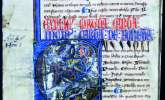
The best picture of him is given by Hrotsvitha of Gandersheim (935-1002 AD), a secular canoness and the first German female poet and historian.
On the one hand, she lauded his court as ‘the brilliant ornament of the world that shines in the west’. On the other, she condemned him as a ‘lewd slave of demons’.
According to Edward Gibbon, at the end of his life Abd al-Rahman said, ‘I have now reigned above 50 years in victory or peace; beloved by my subjects, dreaded by my enemies and respected by my allies. Riches and honours, power and pleasure have waited on my call, nor does any earthly blessing appear to have been wanting to my felicity.’
Abd al-Rahman was the eighth ruler of Al-Andalus since his namesake and great-great-grandfather proclaimed himself emir in Córdoba in 756.
There followed over 700 years of intermittent warfare with the Visigothic Christian counties and kingdoms to the north; campaigns against Muslim rivals in North Africa; and civil wars between and within dynasties only.
It all ended with the surrender of Granada in 1492. As a cultured society, Al-Andalus, the Muslim-ruled area of the Iberian Peninsula, was indeed ‘the brilliant ornament of the world’ and far in advance of the rest of Europe.