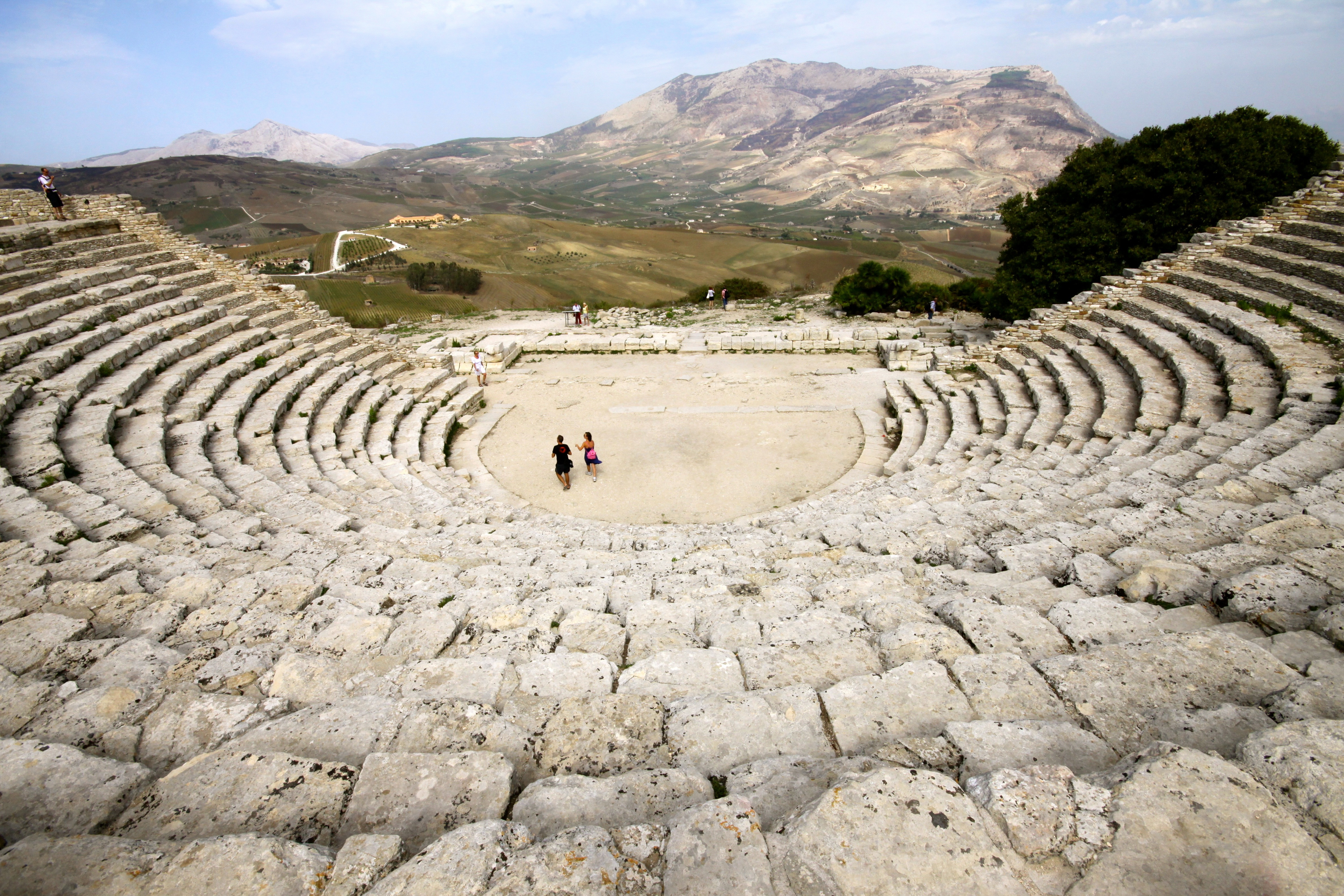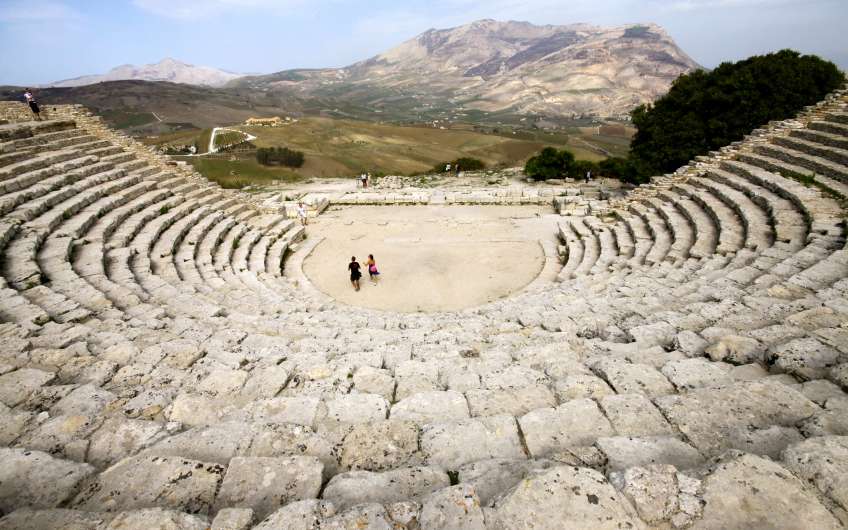

Three Sophocles productions are on, or have recently been on, in the West End: two versions of Oedipus the King and Elektra.
It isn’t just Sophocles who unerringly foreshadows the dilemmas of modern politics and justice. Again and again, the great Greek tragedians – and comedians – got there first.
The earliest surviving courtroom drama was a Greek tragedy. In Aeschylus's Oresteia, a trilogy composed in 458 BC, you aren’t just witnessing the birth of theatre. You’re also seeing the birth of the jury trial, and the foundations of western European justice.
The Oresteia is a sort of sequel to the Iliad, Homer’s epic story of the Trojan War. When Agamemnon, the victorious King of Mycenae, returns home after the war, he finds his wife, Clytemnestra, at it with her lover, Aegisthus. Clytemnestra and Aegisthus proceed to butcher Agamemnon to death in his bath.
Orestes then kills his mother and her lover, Aegisthus. In the first jury trial in European literature, Orestes is tried. Should he be convicted for wrongly killing his mother or acquitted for rightly avenging his father?
The scene would have particularly thrilled the Athenians who first saw the play. The trial is held on the Areopagus – a vast, flat slice of limestone you can still visit, just next to the Acropolis. In real life, the Areopagus was the ancient Greek court of appeal.
The ancient Athenians didn’t just create the first democratic state. They also set up the jury system. And, in the Oresteia, Orestes is tried for matricide by the goddess Athena and a panel of jurors. In real life, Athenian citizens were the first jurors.
The god Apollo is Orestes's lawyer and the murdered Clytemnestra is represented in court by the avenging Furies, who've been attacking Orestes since his crime.
At the end of the case, the jury is evenly split. With her deciding vote, Athena declares that Orestes must be acquitted. Justice has prevailed and the tit-for-tat bloodletting, which lets rip in societies free from government and laws, comes to an end.
So why was Athenian drama quite so prescient of modern political dilemmas? Because Athens in the fifth century BC was a free, democratic city – and a rich one, too. In 508 BC, the first democratic reforms were introduced to Athens by Cleisthenes, Pericles’s great-uncle. For the next 180 years, Athens was the first true democracy, with an accompanying boom in literature, architecture and sculpture.
In 490 BC and 480 BC, Athens beat the Persians at the Battle of Marathon and the Battle of Salamis, respectively. From the late sixth century BC, the silver mines at Laurion, near Athens, produced a huge income for the state. And, in the early 5th century BC, Piraeus (still the port for backpackers heading for the Greek islands) took over from the less efficient Phaleron as the crucial Athenian harbour.
Along with all that money in the bank, there was also an unprecedented degree of free speech. It wasn’t quite completely free: the great philosopher Socrates was sentenced to death in 399 BC for impiety and corrupting the young. Thanks to democracy, largely free speech and valuable dramatic competitions, fifth century BC Greece witnessed an explosion of literature, art and philosophy – and in Athens in particular: it had double the number of literary festivals of other Greek cities.
In recent years, there has been a marked revival in Greek drama in Britain. In 2015, there were two productions of the Oresteia in London, at the Globe and at the Almeida, after 10 years when there hadn’t been a single one.
Our best actresses have been queuing up to play the blood-drenched Greek heroines. The late Helen McCrory played Euripides's Medea at the National Theatre. Juliette Binoche was Sophocles's Antigone at the Barbican. And Sophie Hunter - Mrs Benedict Cumberbatch, incidentally - directed Benjamin Britten's Phaedra at the Samuel Beckett Festival in Enniskillen.
Kristin Scott Thomas explained why she was drawn to these great, tragic roles. She was sick to death of plays with "teacups", she said, much preferring to star in the gory title role of Sophocles's Electra at the Old Vic.
In her 1925 essay, ‘On Not Knowing Greek’, Virginia Woolf wrote about this continued attraction of ancient drama. It’s in those Greek plays that you find the original human being. Electra, Antigone and Orestes are doing and saying things that haven’t been described before. We meet these characters before, in Woolf’s words, “their emotions have been worn into uniformity”. As she puts it, “The meaning [of the Greek words] is just on the far side of language.”
So if you see any of those Sophocles plays, you’ll be right there at the beginning of Western European thought, witnessing the birth of the political clashes that are still raging today. What a treat!
Et Tu, Brute? The Best Latin Lines Ever by Harry Mount and John Davie (Bloomsbury, £14.99) is out now
Enjoy The Oldie every month. Subscribe to The Oldie.